

How To Repair Cracks In Concrete Balcony
I'g the board president of an 8-story cooperative in Brooklyn that'south planning to undertake a facade restoration program, and nosotros're wondering if we should include the balconies as part of the scope of work. Many of the balconies take cracks and stains, and some of them accept what expect similar niggling icicles on the undersides that baste water. In addition, the metal railings are showing signs of wearable, including some that are rusted and loose. Almost of our balconies are covered with an artificial turf and have aluminum covers forth the edges, and so we're hesitant to rip up everything to do full-scale repairs if we tin can get past with fixing the loose railings and patching the undersides as needed until a later engagement. What'southward the recommended course of action?
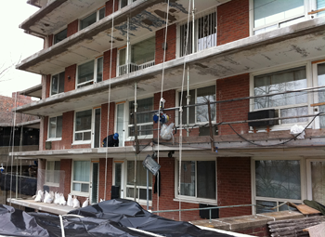 Incorporating balcony repairs into a facade restoration program will save on mobilization and scaffold costs.
If nearly of your edifice's balconies are in the condition you describe, the board will probably take to bite the bullet and undertake a total-scale balcony repair program. The defects you describe are significant, especially if they are widespread. Cracks allow h2o to penetrate the concrete, further damaging it and the underlying reinforcing steel. As the water freezes in the cold weather, the ice expands and creates more cracks, allowing more water to enter and causing more than cracks and more water penetration—a wheel that grows worse with each freeze-thaw cycle.
The "icicles" are stalactites—calcium carbonate deposits (similar to the ones in caves) that form every bit h2o drips from the balcony slab, drawing out the calcareous materials used in physical. Stalactites are a sign of substantial, long-standing water penetration, which could too signal possible harm to the structural steel supporting the balcony.
The loose railings, which are a prophylactic adventure as well as a lawmaking violation, are also a outcome of water infiltration. If the spaces where the railing posts penetrate the concrete are not properly caulked, or the caulking has deteriorated, water seeps in and eventually rusts the posts. As the metallic oxidizes, the rust on the post accumulates and pushes against the surrounding concrete, loosening the posts from their footings and creating additional cracks, allowing more water to enter and furthering loosening the posts.
Balcony Survey
beginning step is to rent a qualified engineer or architect to deport a thorough survey. Working from a scaffold to fully access all the balustrade areas, the engineer/architect will select an apartment line with balconies that show obvious signs of deterioration. Using a mallet to sound out the concrete, the engineer/architect will make up one's mind which areas are the most badly damaged and if the balconies are still structurally sound. Another sign to await for is ponding water, which indicates the balcony is non correctly sloped, preventing proper drainage.
Loose railings are a safety run a risk and a code violation.
As office of the survey, the engineer/builder may asking investigative probes of the physical (conducted by a contractor) to determine underlying conditions. In some cases, the engineer/architect may determine that a core sample—an approximately 4-inch-wide circular cut through the entire thickness of the concrete—needs to be taken. The cadre sample volition be tested to determine the compressive forcefulness of the concrete; it will as well show the extent of impairment through the unabridged thickness of the concrete slab. Investigative probes will make up one's mind if the steel reinforcement is rusted, which could lead to structural weakness. Keep in mind that to fully view the balconies' surfaces and comport the probes, the carpeting and any other type of covering likewise equally the aluminum cladding volition have to be removed.
Based on the survey findings, the engineer/builder will recommend whether a full-scale repair program is needed or if limited repairs volition suffice. In your edifice'southward instance, a balustrade repair programme would probably entail extensive physical repairs and the installation of new railings. If the balconies are extremely damaged, they may demand to be complete demolished and rebuilt.
Concrete Repairs
While financially strapped boards may exist tempted to hire a contractor to make spot repairs such as patching and caulking, the underlying deterioration in the concrete will remain and merely grow worse. To properly repair the concrete, the lacking areas must be entirely cut abroad. The cuts should exist straight, non beveled or tapered, and the cut surfaces must then be scarified—i.e., given a rough texture by mechanical means—and a bonding agent applied and then the new concrete properly adheres to old. If missing, a drip border—a narrow groove several inches from the edge on the balcony's underside, extending the length of the balcony—should be made to help direct dripping water abroad from the building.
Carpeting traps water on balconies, deteriorating the concrete.
After the concrete repairs are made, a non-sideslip traffic-bearing coating system should be applied to the balcony floor and curb surfaces. A non-permeable coating system is applied to the balcony fascia surfaces, while a permeable coating is practical to the underside so the surface can breathe and allow water vapor manual. Coating systems come in a multifariousness of colors.
Ironically, sometimes repairing the physical balcony floors and applying a blanket arrangement really increases ponding. The paradox is caused by two factors. Showtime, water that used to enter through cracks in the concrete at present stays on the surface because the cracks have been repaired and the non-permeable blanket arrangement prevents water from seeping in. Keeping water from penetrating the concrete is desirable, of course, and the point of making repairs. The 2nd factor, even so, is if the balustrade is non properly pitched toward the drain (normally located near the balcony door), h2o pools in depressions in the balustrade surface. The remedy requires the application of a new layer of tapered concrete to accomplish the correct slope and then that water properly drains.
Aluminum Cladding
Cladding is sometimes installed on new balcony curbs as an added protection, or on deteriorated physical curbs in a misguided try to prevent further water infiltration. In some cases, aluminum cladding is fifty-fifty used to hold crumbling concrete pieces together. At best, the aluminum only temporarily blocks water. The cladding typically loosens over time, allowing more water in and trapping it, causing significant impairment to the underlying concrete. Once repairs are made, the balcony edges should be left exposed.
Railings
Loose, rusted railings should be repaired or replaced depending on the severity of the deterioration. Railing posts will accept to be removed from the concrete, and the defective physical surrounding it cut abroad. Information technology is recommended that the posts be inserted into stainless steel sleeves or sleeve openings that are then filled with epoxy. Sometimes a cushioned filler called backer rod, which is topped off with caulking at the base of the mail service penetration into the concrete, is used to go on h2o out.
If y'all're replacing the entire railing organization, you may want to consider aluminum instead of metallic. With a proper finish, aluminum does non rust and therefore requires far less maintenance than metal since it does not need to be regularly scraped, primed, and painted. New York Metropolis Building Code requires railings to be at to the lowest degree 42 inches to a higher place the finished surface on the balustrade. If a layer of concrete has to be added to the balcony to achieve the proper slope for drainage (equally described to a higher place), the new layer may reduce the elevation between the peak of the railing and the balcony surface. The engineer/builder should account for this tiptop departure when specifying the repair scope and railing pattern.
Maintenance requirements for the new balconies should exist minimal.
Since the building will be undertaking a facade restoration program, it makes sense to comprise the balcony work every bit function of the overall repair programme to avoid paying twice for mobilization and scaffold costs. The contractor will likely work on one apartment line at a time, so the board should have acceptable time to requite residents notice to remove all items from their balconies, including article of furniture, planters, rugs, personal items, etc.
Equally part of the repair program, the contractor may demand to file an ACP-five grade to confirm there is no asbestos-containing cloth in the railing's paint or in the balcony'southward existing sealant or coating. You lot'll besides need a piece of work permit from the New York City Departments of Buildings, besides as a permit from the Landmarks Preservation Commission if your building is located in an Celebrated District.
Maintenance
Once the new repairs are in place, maintenance of the new balconies should exist minimal. The caulking around the railing posts should be periodically checked and re-caulked as needed to prevent water penetration. Balcony drains should exist kept costless of debris, and residents should take care non to drag piece of furniture or sharp edges across balcony surfaces as this could scratch and compromise the blanket system.
Finally, residents should not encompass their balconies with whatever blazon of carpet, which traps h2o and keeps the balustrade surface constantly wet, accelerating deterioration. Rug as well hibernate cracks and makes maintenance more than difficult.
At that place's no getting around it: A full-calibration balustrade repair program is a major undertaking, simply information technology'due south one that should not be ignored. To preserve the safety and enjoyment of residents, it should be approached with the same level of consideration equally other large-scale exterior projects.
Stephen Varone , AIA is president and Peter Varsalona , PE is principal of RAND Technology & Compages, DPC . This column was originally published in the July/August 2022 issue of Habitat Mag.

Source: https://randpc.com/ask/exterior-repair-and-maintenance/balcony-repairs
Posted by: nortondregat.blogspot.com
0 Response to "How To Repair Cracks In Concrete Balcony"
Post a Comment